As 2026 comes to a close, business owners and managers are busy reviewing financial results, finalizing budgets, and setting goals for the new year. But there’s one important area that shouldn’t be overlooked during the planning process: Human Resources.
For many small and midsized businesses, HR tends to be reactive. Employee issues get addressed when they arise, hiring happens when there’s an immediate need, and policies are updated only when something goes wrong.
While this approach may work in the short term, it can create unnecessary risks and challenges over time.
The end of the year is an ideal opportunity to step back, evaluate your HR practices, and make sure your business is prepared for what’s ahead. You don’t need to conduct a complete HR overhaul before January 1. Instead, focus on identifying potential gaps, prioritizing necessary updates, and developing a plan to address them.
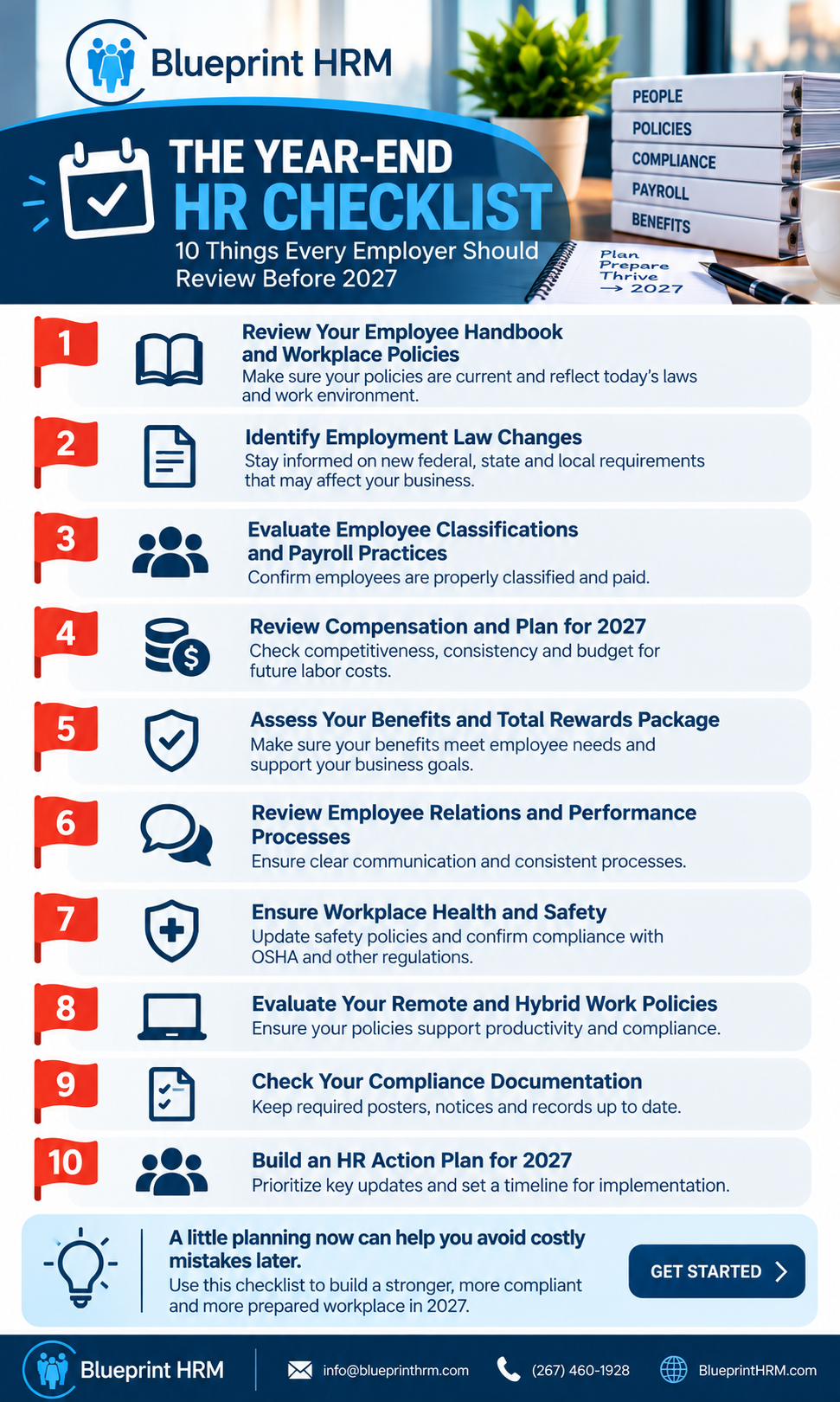
Here are 10 important HR areas every employer should review before heading into 2027.
1. Review Your Employee Handbook and Workplace Policies
When was the last time you updated your employee handbook?
If your handbook hasn’t been reviewed recently, there’s a good chance some of your policies no longer reflect current employment laws or the way your business operates. Employee handbooks should be reviewed regularly to account for changes in legislation, business practices, and employee expectations.
Pay particular attention to policies involving:
- Paid time off and sick leave
- Attendance and timekeeping
- Anti-harassment and discrimination
- Workplace accommodations
- Remote and hybrid work arrangements
- Employee conduct and disciplinary procedures
Remember, a handbook isn’t just a compliance document. It also helps communicate expectations, establish consistency, and provide managers with guidance when employee issues arise.
Year-End Action: Check when your handbook was last updated and identify policies that may need attention before 2027.
2. Identify Employment Law Changes That Could Affect Your Business
Employment laws continue to evolve at federal, state, and local levels. Depending on where your employees work, new requirements may affect wages, leave benefits, hiring practices, and workplace policies.
Businesses with employees in multiple states need to be particularly careful, as different requirements may apply in each location.
Areas to monitor include:
- Minimum wage changes
- Overtime and employee classification requirements
- Paid sick leave and family leave laws
- Pay transparency requirements
- Anti-discrimination and workplace accommodation obligations
- Required employee notices and workplace postings
Keep in mind that not every employment law change takes effect on January 1. Employers should maintain an ongoing process for monitoring applicable requirements throughout the year.
Year-End Action: Identify any confirmed employment law changes affecting your business in 2027, including their effective dates, and create a plan to implement necessary updates.
3. Evaluate Employee Classifications and Payroll Practices
Payroll mistakes can be expensive, particularly when they involve overtime, employee classification, or inaccurate timekeeping. Year-end is a good time to review whether employees are classified and paid correctly.
Consider the following questions:
- Are employees properly classified as exempt or nonexempt under applicable wage-and-hour laws?
- Are nonexempt employees accurately recording all hours worked?
- Is overtime being calculated and paid correctly?
- Are employees receiving at least the applicable minimum wage?
- Are payroll deductions appropriate and properly documented?
- Are independent contractors correctly classified?
One common misconception is that paying an employee a salary automatically makes them exempt from overtime. In reality, exemption generally depends on applicable salary and job-duty requirements, subject to specific exceptions.
Year-End Action: Review job responsibilities, employee classifications, and payroll practices to identify potential wage-and-hour compliance concerns.
4. Review Compensation and Plan for 2027 Labor Costs
Compensation planning is about more than deciding who should receive a raise. Employers should consider whether their pay practices are competitive, consistent, and aligned with business goals.
Questions to consider include:
- Are salaries competitive for your industry and geographic area?
- Are employees performing similar work being compensated consistently, with legitimate reasons for any differences?
- Are merit increases or market adjustments needed?
- Have you accounted for potential changes in minimum wage requirements?
- What impact will benefit renewals and other employment costs have on your budget?
Even if your business isn’t planning across-the-board salary increases, having a consistent approach to compensation decisions can help support employee retention and reduce potential pay equity concerns.
Year-End Action: Review compensation levels, identify potential inconsistencies, and incorporate anticipated labor costs into your 2027 budget.
5. Audit Employee Files and Employment Documentation
Employee records are one of those HR responsibilities that can easily be overlooked until documentation is needed. Incomplete or improperly maintained records can create challenges during audits, employee disputes, unemployment claims, or other employment-related matters.
Review whether your employee files contain the appropriate documentation, including:
- Signed offer letters and employment agreements
- Completed onboarding documents
- Handbook acknowledgments
- Performance evaluations and disciplinary records
- Required certifications or licenses
- Relevant employee notices and acknowledgments
Form I-9 compliance deserves particular attention. Employers should verify that required forms are complete, properly retained, and stored in accordance with applicable requirements.
Medical and other confidential records should also be maintained separately from general personnel files, with appropriate access restrictions.
Year-End Action: Conduct a sample audit of employee records to identify missing documents, inconsistent practices, or retention issues.
6. Review PTO, Sick Leave, and Other Leave Policies
Time-off policies can become surprisingly complicated, particularly for employers operating in multiple states. Different jurisdictions may have specific requirements related to paid sick leave, accrual rates, carryover, usage, employee notices, and recordkeeping.
Additionally, employers should review how their policies interact with applicable federal and state leave laws, including the Family and Medical Leave Act (FMLA), where applicable.
Consider:
- Are PTO and sick leave balances being tracked accurately?
- Do accrual and carryover practices comply with applicable requirements?
- Are managers applying leave policies consistently?
- Are employees receiving required notices about their leave rights?
- Are leave requests being evaluated appropriately for potential accommodation obligations?
Employers should also ensure that payroll systems and written policies reflect the same practices.
Year-End Action: Review leave balances, accrual practices, and written policies before the start of the new year.
7. Evaluate Employee Performance and Development
Year-end is a natural time to reflect on employee performance, accomplishments, and opportunities for growth. However, performance management shouldn’t be limited to a once-a-year evaluation. Employees benefit from regular feedback, clear expectations, and conversations about professional development.
As you prepare for 2027, consider:
- Have employees received meaningful feedback about their performance?
- Are managers addressing performance concerns promptly and consistently?
- Are expectations and goals clearly communicated?
- Are there employees who could benefit from additional training?
- Are there opportunities to promote or develop employees internally?
Performance discussions also provide an opportunity to recognize contributions and strengthen employee engagement.
Year-End Action: Schedule performance and development conversations, establish clear goals, and identify training opportunities for 2027.
8. Update Job Descriptions and Organizational Responsibilities
As businesses grow, employee responsibilities often evolve. Unfortunately, job descriptions don’t always keep pace. An employee who was hired to perform one set of duties may now be handling significantly different responsibilities.
Outdated job descriptions can create confusion about expectations and make it more difficult to evaluate performance, determine appropriate compensation, or assess wage-and-hour classifications and accommodation requests.
Review whether job descriptions accurately reflect:
- Primary responsibilities
- Essential job functions
- Required skills and qualifications
- Reporting relationships
- Supervisory responsibilities
- Current working conditions
Year-End Action: Prioritize job descriptions for positions that have changed significantly or are expected to evolve in 2027.
9. Review Required Training and Workplace Notices
Employers have a responsibility to ensure that employees receive certain workplace information and training, depending on applicable laws and the nature of their business.
Requirements may include:
- Harassment prevention training
- Workplace safety training
- Industry-specific certifications
- Required labor law posters
- Employee rights notices
- Training related to workplace policies and procedures
Some training requirements vary by state, municipality, employer size, or industry. Remote employees may also require special consideration when it comes to accessing required workplace notices.
Beyond legally required training, employers should consider whether supervisors need additional guidance on handling employee concerns, documenting performance issues, and recognizing situations that should be escalated to HR.
Year-End Action: Review completed training, identify upcoming deadlines, and confirm that required workplace notices are current.
10. Develop Your 2027 Workforce and HR Plan
Finally, take a broader look at how your people practices support your business goals. If your business is planning to grow, expand into new markets, introduce new services, or make organizational changes, your workforce needs may change as well.
Consider:
- Will you need to hire additional employees?
- Are there positions that have become difficult to fill?
- Do you have employees who could grow into leadership roles?
- Are your managers equipped to supervise and support their teams?
- Are there recurring employee issues that suggest a need for clearer policies or better processes?
- Do you have the HR resources needed to support your plans?
For smaller businesses, HR planning doesn’t need to involve an elaborate strategic plan. Even identifying three or four priorities for the upcoming year can make a meaningful difference.
Year-End Action: Establish your top HR priorities for 2027, assign responsibility, and create realistic timelines for addressing them.
Where Should You Start?
Looking at a list of 10 HR priorities may feel overwhelming, particularly if you’re a business owner who already wears multiple hats. The good news is that you don’t need to tackle everything at once. Start by identifying the areas that present the greatest risk or have the biggest impact on your employees and operations.
A practical approach is to divide your priorities into three categories:
Address Immediately: Compliance concerns, missing required documentation, or practices that could create significant legal or financial exposure.
Address Within 30-60 Days: Policy updates, job description revisions, manager training, and improvements to existing HR processes.
Plan for 2027: Longer-term initiatives such as employee development programs, compensation planning, succession planning, and improvements to your overall HR strategy.
The goal isn’t perfection. It’s making consistent progress toward stronger, more effective HR practices.
How Blueprint HRM Can Help
At Blueprint HRM, we understand that small and midsized businesses don’t always have the time, resources, or internal expertise to manage every aspect of HR. That’s where we come in.
We partner with businesses to provide practical, personalized HR support, whether that means conducting an HR compliance assessment, updating an employee handbook, reviewing employment practices, or serving as an ongoing HR resource.
Our goal is to help you identify potential risks, establish effective practices, and address employee matters with confidence.
Not sure where your business stands?
A year-end HR review is a great place to start. We can help you identify priorities and develop a realistic plan for addressing them. Let’s make sure your business is ready for 2027.