Most business owners don’t intentionally ignore HR risk. In fact, many organizations have solid HR practices in place. The challenge is that HR risk doesn’t always announce itself.
An employee handbook that was compliant a few years ago may now be outdated. A manager may be handling performance issues differently than another manager. An employee who has always been treated as exempt may not actually meet the requirements. Hiring practices that worked when you had 15 employees may create challenges now that you have 50. And sometimes, the first indication that there’s a problem is an employee complaint, a wage and hour issue, an unemployment claim, or a difficult termination.
That’s why periodically taking a broader look at your HR practices is so important.
HR Risk Goes Beyond Compliance
When we talk about HR risk, employment law compliance is certainly part of the conversation—but it’s not the only consideration. Strong HR practices also help create consistency, improve documentation, give managers clearer guidance, and make it easier to address employee issues when they arise. Some of the areas businesses should periodically evaluate include:
- Employee handbooks and policies: Are they current and appropriate for where your employees work?
- Hiring and onboarding: Are your processes consistent, compliant, and well documented?
- Employee classification: Are employees properly classified as exempt or non-exempt? Are independent contractors classified appropriately?
- Wage and hour practices: Are timekeeping, overtime, and payroll practices being handled correctly?
- Employee relations: Do managers know how to document performance concerns and respond to employee complaints?
- Leave administration: Are requests for FMLA, ADA accommodations, paid sick leave, and other protected leave handled appropriately?
- Performance management: Are employees receiving regular feedback, and are performance issues addressed consistently?
- Personnel records: Are required documents maintained, organized, and appropriately separated?
- Manager training: Do supervisors understand their responsibilities when managing employees?
Individually, a small gap may not seem significant. But multiple gaps can create unnecessary risk for an organization.
“We Haven’t Had Any Problems” Isn’t a Risk Management Strategy
One of the most common reasons businesses put off reviewing their HR practices is simple: nothing has gone wrong yet. That’s good—but it doesn’t necessarily mean everything is being handled correctly. HR practices tend to develop over time. A policy gets added in response to one situation. A manager develops their own approach to handling attendance issues. A new state or local employment law takes effect. The company grows past an employee-count threshold that triggers additional requirements. Before long, the organization may be operating with a collection of practices that haven’t been reviewed together. A proactive HR review gives you an opportunity to identify those gaps before they become employee relations, compliance, or operational problems.
How Strong Is Your HR Foundation?
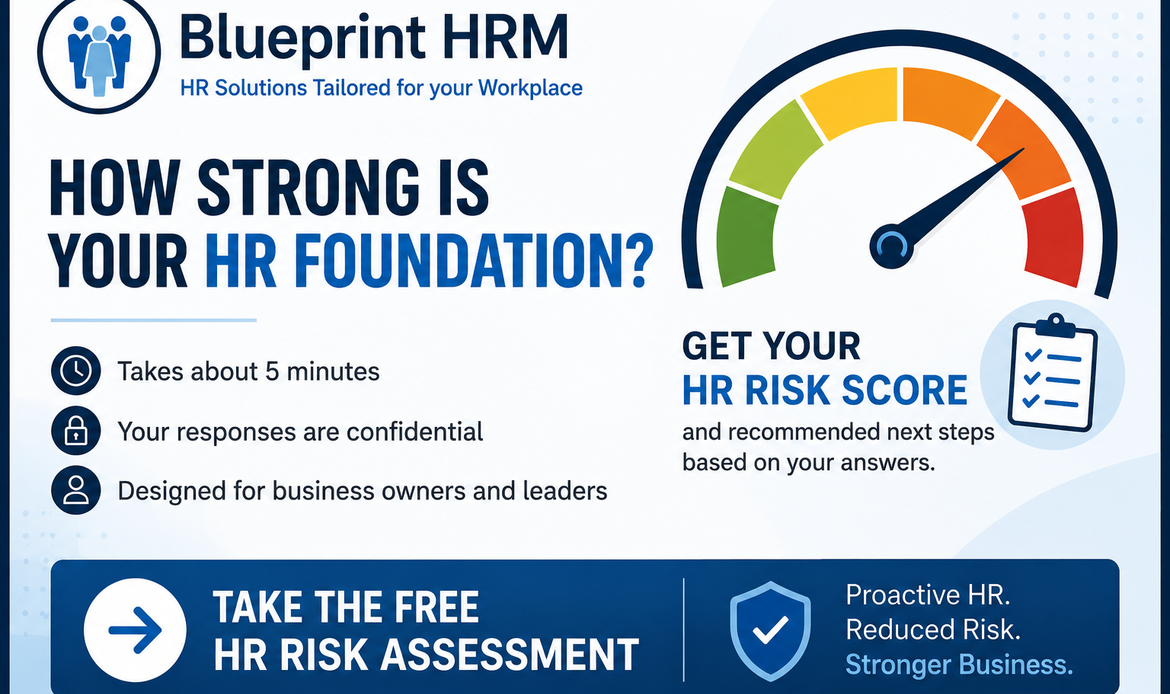
To help business owners and leaders get a quick snapshot of their current HR practices, Blueprint HRM created a Free HR Risk Assessment. The assessment takes about five minutes and reviews key areas of your HR function. After you complete it, you’ll receive a personalized HR Risk Score along with recommended next steps based on your responses.
A low score is good news—it indicates that you likely have a strong HR foundation. But even organizations with relatively low risk can benefit from periodically validating their practices and looking for opportunities to improve. A moderate or higher score may indicate that there are areas that deserve more immediate attention. Either way, the goal isn’t simply to identify what’s wrong. It’s to help you understand where you stand today and where it may make sense to take a closer look.
What Happens After the Assessment?
Your results are a starting point, not a comprehensive HR audit. If you’d like to go deeper, Blueprint HRM can conduct a comprehensive HR Assessment to review your HR function as a whole—including policies, documentation, compliance practices, employee processes, and day-to-day HR operations. From there, we can help prioritize what needs attention, determine what’s working well, and develop practical recommendations based on your organization.
Ready to see how your HR practices measure up?
Complete the free HR Risk Assessment:
The Blueprint HRM HR Risk Assessment is provided for educational and informational purposes and is not intended as legal advice or a comprehensive compliance audit.
Strong HR practices don’t happen by accident. Taking the time to periodically evaluate your HR foundation can help you identify potential risks before they become problems and ensure your practices continue to support your business as it evolves. Whether your assessment identifies areas for improvement or confirms that you’re on the right track, Blueprint HRM can help you determine what comes next. Contact us to discuss your results or learn how a comprehensive HR Assessment can help strengthen your HR practices and reduce risk.